Every autumn the same thing happens on streets across Alexandria and Fairfax County. The leaves come down, the yard chores get listed, and somewhere a crew takes the tops off a row of crape myrtles. By Thanksgiving the neighborhood is wearing the same haircut: bare stubs at chest height where a graceful multi-stemmed tree used to stand. It feels like tidying up. For this particular tree, it is the wrong season and the wrong cut.

Why the autumn chop is a mistake
Crape myrtle is forgiving enough to make bad practice look like it works. Cut it back to stumps and it will still bloom the next summer, because it flowers on the growth it makes that year. The homeowner sees flowers and repeats the cut every fall. The damage shows up more slowly. Virginia Cooperative Extension's guide to pruning crapemyrtles says heavy topping cuts increase stem decay, and that the flush of shoots which replaces the removed wood is weakly attached and top heavy, so those shoots tend to break in strong wind.
What the plant wants instead
Three things line up in the back half of winter that do not line up in October. The first is the flowers: because blooms form on current-season wood, dormant pruning costs you nothing, since the wood that will carry this summer's flowers has not grown yet. The second is cold. Extension guidance warns against pruning in late summer or early fall, because the new shoots that flush in response may not harden off before they freeze. The third is visibility. A bare crape myrtle shows every crossing limb, every stub and every place two stems are rubbing.
That is why extension offices in Virginia and Arkansas give nearly the same advice: finish before the buds break, ideally by mid-February in a normal Northern Virginia winter. The simplest way to remember the rule is late-winter pruning for crape myrtles in Northern Virginia, done while the buds are still tight, and never once the tree has leafed out.
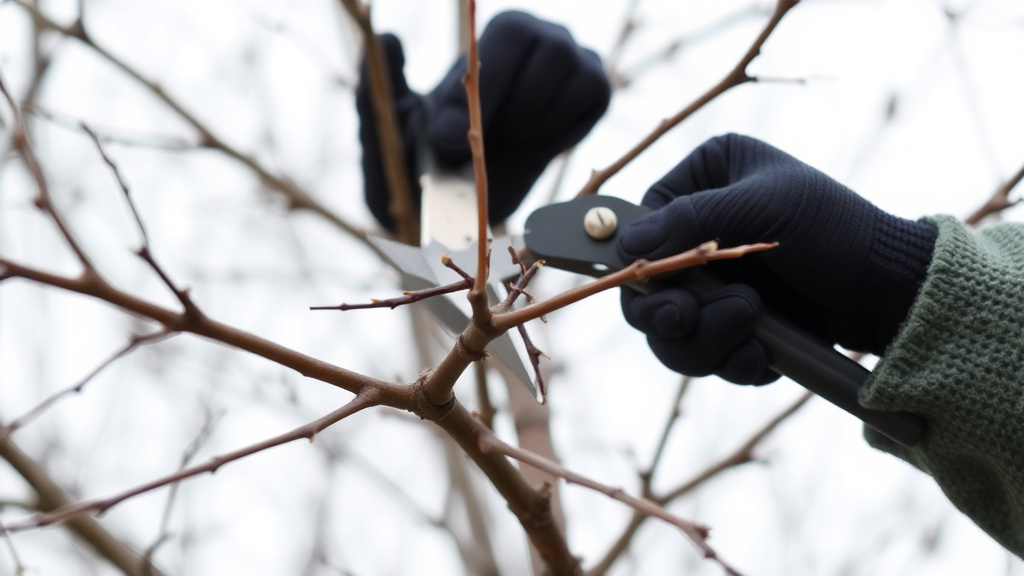
How to cut
- Cut back to a bud, a side branch or the main stem, never to an arbitrary height.
- Remove small branches that cross or rub before they wound each other.
- On a young plant, take lower limbs off gradually so the trunks stay clean as the canopy lifts.
- Rub or snap off thin suckers at the base while they are young, before they turn woody.
- Leave the spent seed heads alone unless you dislike the look. Extension sources treat them as cosmetic, not harmful.
What autumn is actually for
Fall is not wasted on a crape myrtle. It is when you can plan. Tie a ribbon on dead limbs while the leaves are still on, because that is when the bare ones are easiest to spot, and you will find them again in February when every branch looks lifeless. Photograph rubbing branches from a couple of angles. Rake fallen leaves away from the base and pull mulch back off the trunk, since mulch piled against bark is a year-round problem.
It is also the moment to ask whether pruning is really the issue. If a tree has to be cut back every year to clear a walkway, a window or a roofline, it may have been planted too close to the house or be a full-size cultivar in a small space. Full-size varieties can reach 20 feet or more, while dwarf types stay much smaller.
Where the do-it-yourself job ends
A young crape myrtle you can reach from the ground is a Saturday job with hand pruners and a bypass lopper. The job changes when your feet leave the ground. Overhead cuts with a saw put the weight of the limb, the reach of the tool and your balance in play at once, and thin crape myrtle bark shows a torn cut for years. Anything near a roof, a driveway or a utility drop belongs to someone with rigging and insurance. For related reading on this blog, see Top Tree Pruning Tips to Nurture Your Alexandria, VA, Trees and Pruning Fruit Trees in Alexandria, VA: A Comprehensive Guide for Homeowners.
G&V Tree Service is a family-owned company based in Springfield that has worked across Northern Virginia since 2001. Its ISA Certified Arborists belong to the International Society of Arboriculture and the Tree Care Industry Association, the crew that assesses a tree is the crew that does the work with no subcontractors, and the on-site estimate is free.
From Brookfield Park to the G&V office
Brookfield Park in Springfield is a familiar spot for neighbors in the area. The map below shows the drive from Brookfield Park to the G&V Tree Service office on Brandon Avenue in Springfield.
G&V Tree Service Inc · 6434 Brandon Ave, Suite 204, Springfield, VA 22150 · (703) 569-2570
Quick answers
Can I prune a crape myrtle in October?
Extension guidance advises against it, because fall cuts push new growth that may not harden off before freezing weather.
Will pruning in winter cost me flowers?
No. Crape myrtles bloom on the growth made in the current season, so winter cuts shape where blooms will form.
What is crape murder?
It is the nickname for topping a crape myrtle to stumps, a practice that increases decay and leaves weakly attached shoots.